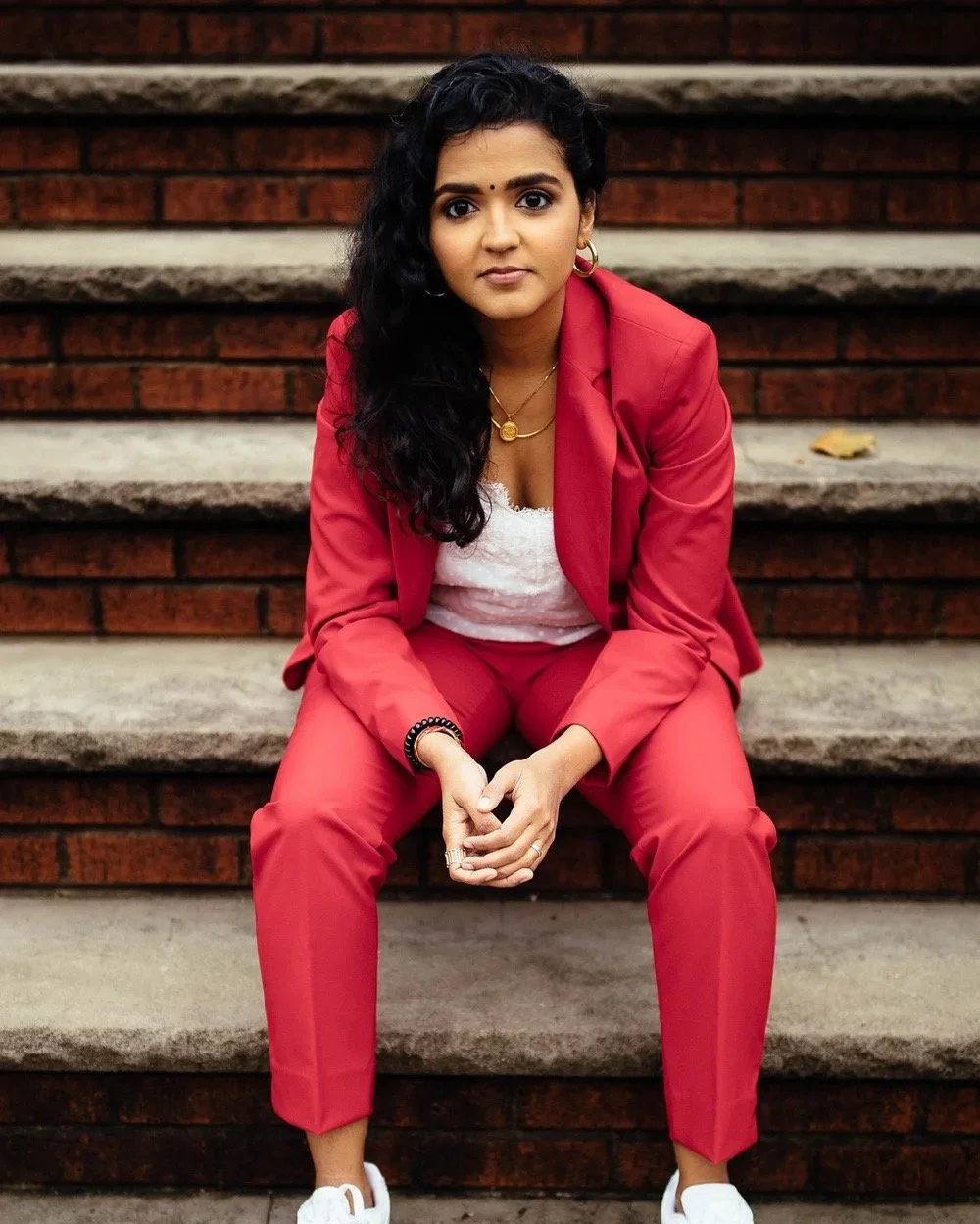
Deepti Sharma, Keynote Speaker and Serial Entrepreneur
Can you tell us a little more about the business you started, Food to Eat, and what it does?
We focused on the immigrant women and minority-owned restaurants and food trucks, because a lot of the time they don't get the opportunities to get big contracts at large corporate offices. These amazing small business owners weren't getting catering opportunities. What we wanted to help them do was access orders on a consistent basis. For corporations, we were focused on helping them think about how they help local businesses get in the door, instead of just always ordering from the same restaurants and food trucks. We sell our product to office managers who work at Warby Parker or Microsoft, and they go on our website and order meals for 10 people, 300 people, even 500 people. That was my first company.
I started my second company with my husband. It’s not as exciting, but it's software for restaurants. When you order from restaurants, they don't know anything about you.We helped create software that aggregated all of that data from Uber Eats, DoorDash, any platform that anyone uses to order food from the restaurant. We help put it all in one place and help restaurants know who India is, what she likes to eat, so that when they reach back out to you, they're not telling you, “Hey, India, should be ordering our coffee,” when you don’t really like coffee. But India really loves the desserts at your restaurant, so that's what you should be marketing. For us, it was how do we use data to help restaurants talk to their customers better.
I also teach entrepreneurship. I became Barnard's first entrepreneur in residence. I helped student entrepreneurs on campus figure out what companies they want to start, what problems they want to solve. To me, entrepreneurship is a tool to solve problems within your community. If you see a problem, I say, “Okay, how can we help you solve it?” So at Barnard, I focus on the biggest problems you see in the world and how to solve those problems.
What inspired you to run for New York City Council?
I was born and brought up in Queens, New York. I worked in politics when I was in college. I worked on many different campaigns, and I saw candidates who really believed in their communities and wanted to do better for them. I saw what it was like when candidates got elected and what they were able to do.
In 2020, my first company was feeding offices, but when everyone was working at home because of COVID, our company took a really big hit. We went from a million dollars in revenue to zero in a day because nobody was ordering food from us anymore. Nobody was in their offices. That moment we started realizing lots of people were food insecure and didn't have money. They had lost their jobs at the restaurant. We started fundraising money to help feed people and to help keep our restaurants alive. We raised over $50,000, and I was out on the streets serving, I was giving out free meals to families who needed them, frontline workers, doctors and nurses at hospitals. I was thinking about all these people out on the streets who didn't have money for rent or food, who weren't able to get jobs because of the pandemic. At that moment, I said to myself, “What more can I do to help my community?”
That was my inspiration to run for office: Being out on the streets of New York City in the pandemic. In New York City, when you run for city council, you're affecting the day-to-day lives of people—from how much money and funding schools get to the garbage getting picked up. All of these things help people’s quality of life. As a mother, I kept thinking that if I saw these problems, other parents were seeing the same. And I wanted to be an advocate for other parents, families, and community members.
Did you always want to be an entrepreneur when you grew up, and if not, what did you want to be?
I don't know if I knew that I wanted to be an entrepreneur. I didn't know that it was an option for me. I always thought of being a lawyer because I wanted to fight for people’s rights. I wanted to be a social justice lawyer and speak up for the voiceless. I didn't think entrepreneurship was a thing for me until I was in college. The way I started my company, I was actually studying for my LSATs, but I was standing online at a food truck, and I waited a really long time. I'm from New York. We don't like waiting in lines. I'm very impatient sometimes. I said to myself, how do I get access to this food truck without having to stand on this line? That moment led me to start talking to food truck and cart owners and understanding some of the issues they face. Then I became an entrepreneur, but it wasn't the first thought I wanted to start a company. Now I've started two. I love starting companies. I love being able to solve different problems through entrepreneurship. I think that my inspiration really came from when I was standing in that line after college.
What is your favorite part of your job?
I would say my favorite part is solving problems that really help people. Once we started being able to provide more orders for food trucks and restaurants that had never seen orders this big coming into their restaurant, we saw them expanding.
I saw one restaurant open up a second location; they had to rent another space to handle the business that we were giving them. I think the most exciting part is how your business can actually change lives. I've always valued the conversations that our customers have with us. When they tell you what’s working and what’s not, that feedback was really great for us to continue building our business. The conversations I had with our customers were probably my favorite because you learn why they wanted to start their restaurant. We were able to bring different kinds of food into offices, like Ethiopian or Ghanaian. This was not just so employees could try the food, but also so they could see themselves in the food. If somebody at the office is from Senegal and is like, oh my God, my company just ordered Senegalese food, that may spark some joy in them. I loved how the small effect of what we did showed up in so many different ways.
What is the hardest part of your job?
In the beginning, the hardest part of my job was convincing other people that I was the right person to start this company, because I had never started a company before. I was fundraising, and I was by myself, but they didn't know I could do it. They didn't know my track record. They didn't know how motivated and focused I could be. I would say that the hardest part is always starting and then finding a way to convince others.
Who is your favorite woman role model?
The cliche answer will come first, which is someone like my mom. She came to this country and got married when she was very young, 18 years old. She didn't speak much English and didn't understand anything happening here. She didn't understand the school system. But my parents started multiple businesses together and put us through high school and college, and were able to figure everything out without the existence of the internet and AI tools that we use today. She was able to figure things out. Her resilience has stayed with me to keep believing in myself and to keep pushing myself even though things may seem hard. I would say my mom was my mentor and someone I look up to every single time I think, “Oh, I can’t do this.” My mom didn't have many resources. Her parents weren't even here with her. They lived in India at the time when she got married and moved here. She had to find the courage within herself to continue doing things.
Someone else I look up to who is not a direct mentor is Michelle Obama. I'm reading her book right now, Becoming, and it is so amazing. We see Michelle Obama as the final product right now. She was the first lady, and she was an incredible lawyer. We don't know where she came from—her humble roots and beginnings, how she lived in a really tiny space with her family, how her father had multiple sclerosis. I look up to her in so many ways because I think similar to my mom, you can come from humble backgrounds and beginnings, but you can become anything you want as long as you believe in yourself, you keep rooting for yourself and put yourself in places where you can continue to build your network.
What business might you want to start?
I am actually toying with the idea of starting a new one. I'm consulting right now, helping entrepreneurs and nonprofits that are thinking about growing their teams and figuring out branding and marketing strategies. I’m working with other startups, nonprofit founders, and executive directors to put for-profit practices in the nonprofit world. But the third business I'm starting is in the space of end-of-life care. When people are dying, how do we take care of them? What's happening in this space? I'm in research mode right now. It's the mode where I'm just talking to many people that work in end of life care, whether it's nursing homes or funeral homes. I know it doesn't sound as exciting, but the reason why is that we've had a lot of people pass away in the last six years. I'm toying with what it would be like if I wanted to build something in that space.
What is some advice you have for young entrepreneurs like me looking to start a business?
My advice is always going to be the same. I talked a little bit about it in the beginning. What keeps you up at night? What are the things that are around you that are happening that bother you, that frustrate and annoy you? What is it that you can do to change that frustration? What is happening in your community that you want to see change in? How can entrepreneurship be that tool that you use to bring that change about?
A lot of people think that the only way to solve problems in their community is by starting a nonprofit. I don't think that's necessarily true. I think nonprofits are great, and they do amazing work, but how about starting for-profit businesses that can actually continue to grow, scale and generate wealth in so many different areas?
My biggest advice is to solve the problems that are closest to your heart and then take it from there to find the solution. The last thing I will say is make sure you always talk to the people you're solving for. Sometimes people will start businesses and assume they already know the problem. You want to make sure that it's a bigger problem than just something you feel frustrated by, so that you can build and create something that's going to grow and scale.